
Guides
How SR&ED tax credits and provincial R&D credits affect Canadian launch budgets
Explains how SR&ED tax credits, provincial R&D credits, BDC, ISED support and Canada Small Business Financing Program loans affect Canadian launch budget timing.
What to take away
- Product marketing and go-to-market planning in Canada should treat the Canada Revenue Agency SR&ED tax credit as a cash flow lever, not a footnote in the R&D line.
- The claim process runs on the Canada Revenue Agency's filing calendar, so the refund date sets what you can ship in a given quarter.
- Provincial R&D tax credits stack on the federal creditOntario at 8 percent refundable and 3.5 percent non-refundable, Quebec at 14 percent for smaller firms, and British Columbia at 10 percent refundable for Canadian-controlled private corporations.
- BDC programmes and the Canada Small Business Financing Program can fund launch costs that SR&ED will not touch, including marketing, hiring and working capital.
- ISED support covers advisory services, procurement and innovation programmes rather than direct marketing cash.
- Any launch budget built on assumed credit timing breaks product launch positioning when the refund lands late.
What SR&ED tax incentives are and what work qualifies
The Canada Revenue Agency SR&ED tax credit is a refundable or non-refundable credit for scientific research and experimental development performed in Canada. SR&ED tax incentives reduce the after-tax cost of the R&D that sits behind a product, which frees budget for the launch itself.
For a founder, the practical effect is that a portion of engineering spend can be recovered and redirected to go-to-market work.
The programme is not a general innovation subsidy. It pays for work that advances technology through systematic investigation or search, where you face technical uncertainty and record your hypotheses and tests. A new pricing page does not qualify. A new inference engine that might not work does.
Qualifying work usually falls into three buckets: experimental development, applied research, and basic research. Supporting work counts too when it is commensurate with the R&D, such as data collection, testing and some engineering design. Sales, marketing, legal and routine bug fixes do not qualify.
Eligible costs include salaries and wages for employees doing the work, materials consumed or transformed in the R&D, and a portion of third-party contract payments. Overhead is claimed through a proxy method rather than by tracking every utility bill. Capital equipment is generally outside the credit now.
Small Canadian-controlled private corporations can receive a 35 percent refundable credit on the first $3 million of qualifying expenditure in a year, and a 15 percent non-refundable credit above that threshold. Larger firms and foreign-controlled companies receive the 15 percent non-refundable credit, which offsets tax payable. The $3 million limit shrinks for corporations with taxable capital above $10 million.
The distinction matters for launch planning, because a refundable credit becomes cash in the bank, while a non-refundable credit only helps if you have tax to pay.
For a startup with no revenue, the refundable path is the one that funds the next sprint. That is why the credit belongs in the launch budget conversation, not just the finance team's tax file.
How the Canada Revenue Agency claim process affects launch timing
SR&ED is claimed with your corporate tax return, filed after the fiscal year ends. The Canada Revenue Agency reviews the claim, may ask for supporting documentation, and may conduct a review or audit before releasing the refund. That sequence sets the timing constraint on every launch budget that depends on the credit.
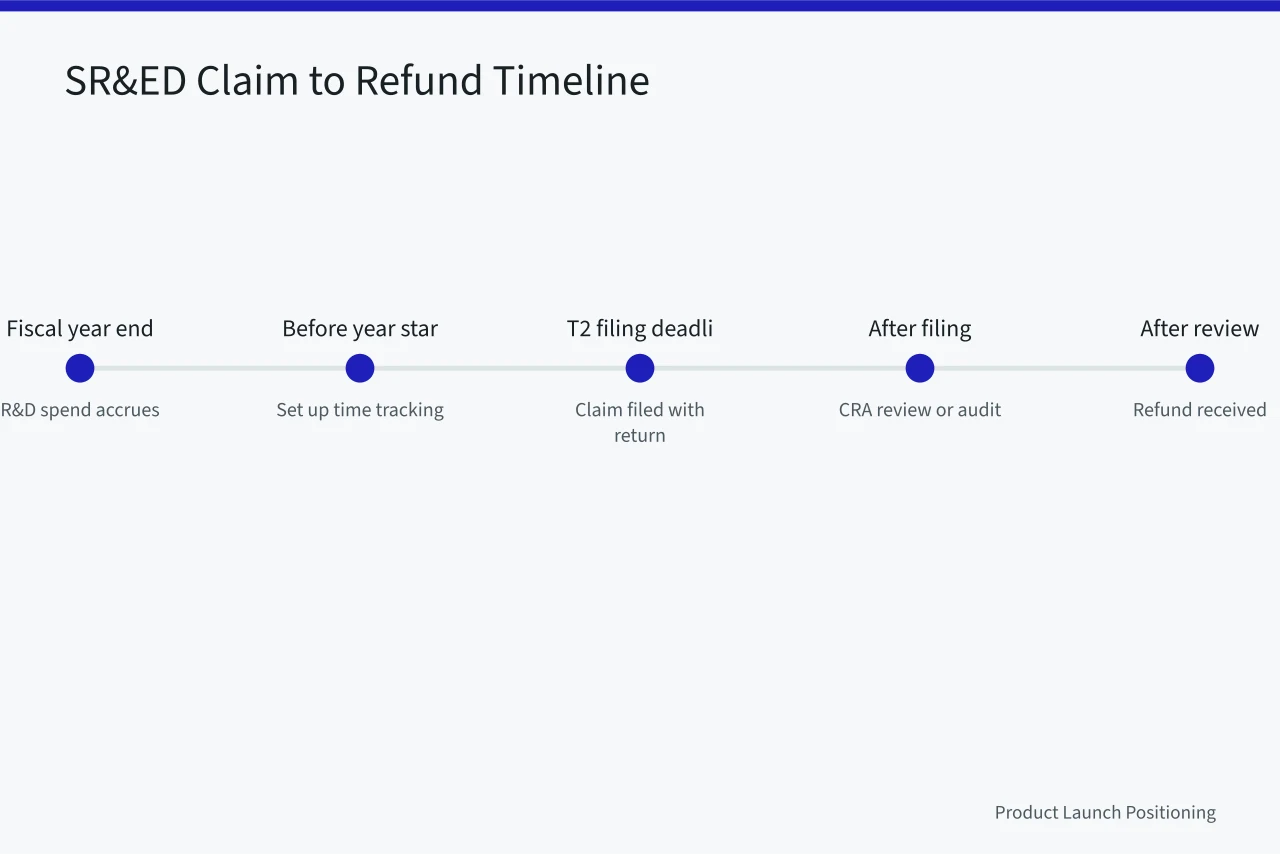
The claim itself is not a form you file in isolation. You report eligible expenditures on the prescribed forms, attach the technical narrative that explains what you tried, what you learned and why it was uncertain, and file with the T2 return. The narrative is where most claims are won or lost.
How the CRA claim process affects launch timing
- Set up time tracking and project codes before the fiscal year starts, so salaries can be split between R&D and non-R&D work.
- Keep contemporaneous records of technical uncertaintytest results, design alternatives, failed approaches and the decisions that followed.
- Review the technical narrative with the person who did the work, not only with the accountant who files it.
- File the claim with the T2 return by the corporate filing deadline, and respond to Canada Revenue Agency requests within the stated window.
- Treat the refund as cash arriving after review, and build the launch calendar around that date rather than around the fiscal year end.
Timing varies with claim complexity, documentation quality and the Canada Revenue Agency's workload. A clean claim with a clear narrative tends to move faster than one that requires follow-up questions. A claim that mixes marketing spend into the R&D pool invites a review that delays everything.
The Canada Revenue Agency's target for reviewing a claim from a Canadian-controlled private corporation is 120 days from receipt.
A useful discipline is to separate the launch budget into two columns: costs you must pay before the refund arrives, and costs you can schedule after it. If the pre-refund column is larger than your runway, the launch date is not real.
This is where a go-to-market strategy for Canadian startups has to be written against cash timing, not against an ideal calendar.
The Canada Revenue Agency also administers GST/HST, and input tax credits on launch spending can improve the cash position while you wait. That is a separate mechanism from SR&ED, but it affects the same launch budget line.
Provincial and territorial R&D credits stacked on the federal credit
Provincial R&D tax credits are calculated separately from the federal credit, and in most cases you claim them on the same corporate return. They can be refundable or non-refundable depending on the province and the claimant.
The federal programme publishes a consolidated list of provincial and territorial credits, which is the right starting point before you assume a rate.
Ontario's innovation tax credit is 8 percent and refundable on the first $3 million of qualifying expenditure, and the Ontario R&D tax credit is 3.5 percent and non-refundable. Both mirror much of the federal definition but use provincial thresholds.
Quebec's R&D salary credit is 14 percent for corporations with assets under $50 million, and 6 percent above that. The province also runs a separate university research credit, and Quebec's rules interact with the federal claim in ways that require care.
British Columbia offers a 10 percent credit, refundable for Canadian-controlled private corporations, which is meaningful for pre-revenue companies in Vancouver and Victoria.
Alberta, Manitoba, Saskatchewan and the Atlantic provinces each have their own treatment, and some rely more on direct programmes than on tax credits. Nova Scotia and New Brunswick, for example, have regional development incentives that can complement a federal claim. The point is that a national launch budget cannot assume a single provincial rate.
Stacking creates two planning problems. First, the combined benefit can be large enough to change the launch decision, which means it should be modelled before the build starts. Second, each province has its own documentation expectations, and a claim that satisfies the Canada Revenue Agency may still need provincial schedules.
Quebec adds a further constraint that has nothing to do with tax: the Charter of the French Language, as amended by Bill 96, affects commercial publications, packaging and contracts. Launch materials aimed at Quebec consumers need French treatment, and that cost belongs in the launch budget alongside the R&D claim.
Treating Canada as one market is the fastest way to underfund a Quebec launch.
BDC programmes and the Canada Small Business Financing Program
The Business Development Bank of Canada fills gaps that tax credits cannot. BDC programmes include working capital loans, growth and transition capital, and advisory services for market expansion. For a launch, the relevant use is often a loan that covers hiring, inventory or marketing while the SR&ED refund is still in review.
BDC lending is commercial, so it comes with interest and covenants. It is not free money, and it should not be used to paper over a launch plan that does not work without it. Used well, it smooths the gap between spending and refund, which is exactly the launch budget timing problem.
BDC does not publish a single rate. Pricing is commercial, set against the bank prime rate and the borrower's profile, and a working capital facility typically starts in the low six figures.
The Canada Small Business Financing Program is a separate federal programme delivered through participating lenders. It supports term loans for equipment, leasehold improvements and some intangible assets, with a government guarantee that reduces lender risk. It is not an R&D programme, but it can fund the physical and operational side of a launch.
The programme's maximum loan is $1.15 million, with up to $150,000 of that available for intangible assets and working capital. Variable-rate loans are priced at the lender's prime rate plus 3 percent at most. The borrower pays a 2 percent registration fee, and the government guarantees 85 percent of the lender's loss.
You can read the programme details on the Canada Small Business Financing Program page.
One caution: the Canada Small Business Financing Program does not fund research and development or marketing spend directly. Its value is in freeing other cash for those lines. A founder who layers a CSBFP loan, a BDC facility and an SR&ED refund is building a capital stack, and each layer has its own timing.
For a fuller picture of what a launch actually costs line by line, including the items Canadian programmes will and will not cover, see this product launch cost breakdown and adjust the currency and programme assumptions for Canada.
ISED programs and initiatives relevant to launch funding
Innovation, Science and Economic Development Canada runs programmes and initiatives that support innovation, but most are not direct cash for marketing. ISED support tends to arrive as advisory services, procurement opportunities, standards work and contributions to regional innovation ecosystems.
The department publishes a consolidated Programs and initiatives list, which is worth scanning before you assume no federal programme applies to you.
For launch planning, the practical ISED touchpoints are threefold. First, innovation programmes that co-fund development work can extend the runway that SR&ED has already stretched. Second, procurement programmes can become a first customer, which changes the launch from a marketing exercise to a revenue exercise.
Third, regional development agencies under the ISED umbrella, such as those serving Atlantic Canada and the Prairies, run their own contribution programmes that vary by region.
ISED also sets the policy context for competition and consumer protection, and the Competition Bureau Canada enforces misleading advertising and pricing rules. Launch claims about performance, pricing or environmental benefits must be substantiated. That is a compliance cost, and it belongs in the budget.
Other federal bodies touch the launch in ways that affect timing. The Office of the Privacy Commissioner of Canada oversees PIPEDA, so any product handling personal data needs a privacy posture before launch.
The Canadian Radio-television and Telecommunications Commission enforces CASL anti-spam rules, which govern commercial electronic messages. A launch campaign that ignores consent rules can attract penalties that dwarf the SR&ED benefit.
Modelling grant timing against a launch budget
The modelling exercise is straightforward if you refuse to mix sources of cash. Build a month-by-month table with spend on one side and confirmed inflows on the other. Only confirmed inflows can fund committed spend.
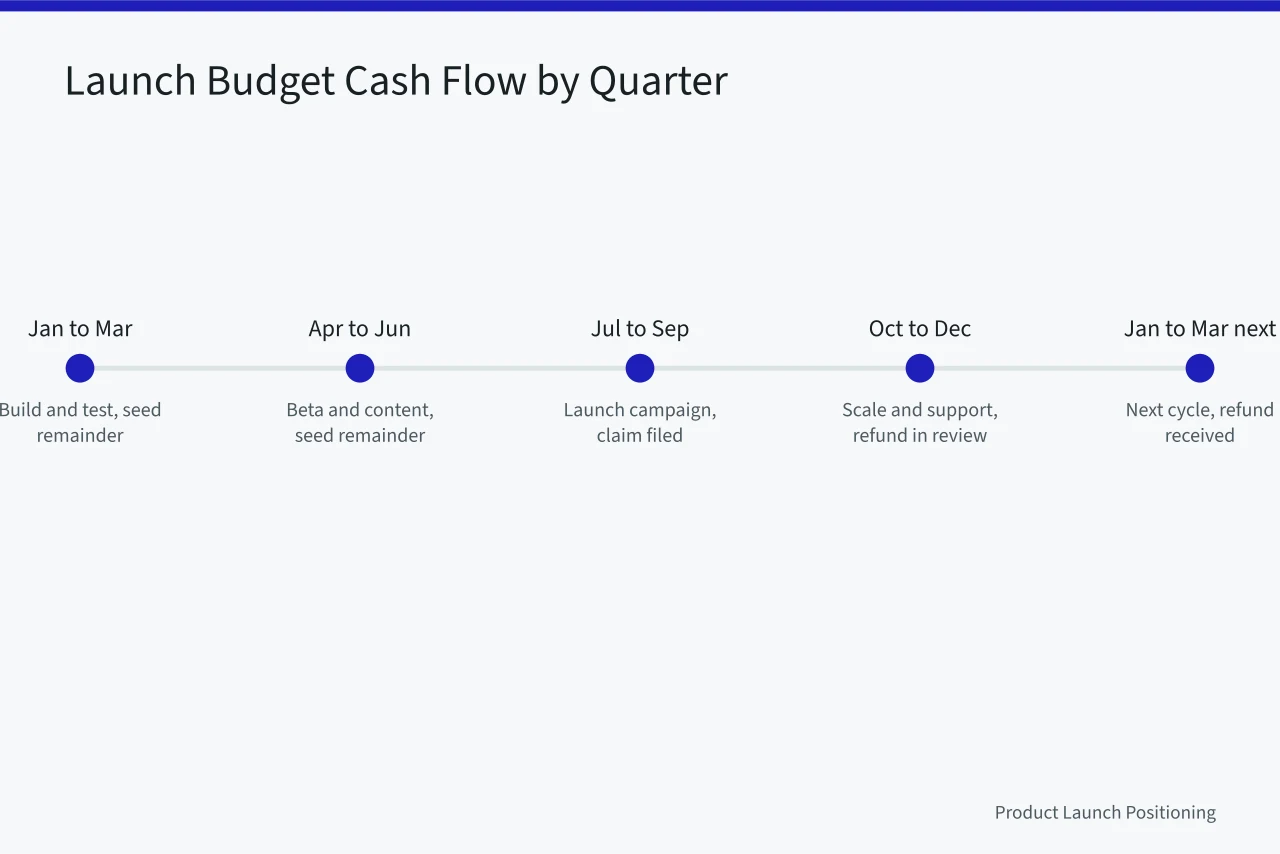
The table below works one example. A Canadian-controlled private corporation with a December year end spends $600,000 on qualifying R&D salaries and launches in Ontario.
The federal credit at 35 percent is $210,000 and the Ontario innovation credit at 8 percent is $48,000. The claim is filed with the T2 the following June, and $258,000 lands in October. Figures are illustrative, not forecasts.
| Quarter | Launch spend | Confirmed cash | Credits received | Gap |
|---|---|---|---|---|
| Jan to Mar | $90,000 | $90,000 | $0 | $0 |
| Apr to Jun | $120,000 | $60,000 | $0 | $60,000 |
| Jul to Sep (launch) | $250,000 | $140,000 | $0 | $110,000 |
| Oct to Dec | $100,000 | $60,000 | $258,000 | $0 |
| Total | $560,000 | $350,000 | $258,000 | $170,000 peak gap |
The critical row is the launch quarter. If the campaign must run before the refund lands, the money has to come from somewhere else: revenue, a BDC facility, a CSBFP loan or a slower launch. That decision is a positioning decision, not just a finance decision.
The gap peaks at $170,000 in September, and the credits arrive in October, so the year closes $48,000 ahead.
- List every launch cost and mark whether it is R&D-adjacent, marketing, compliance or working capital.
- Map each cost to a funding source that can legally cover it, and note the timing of that source.
- Identify the gap between committed spend and confirmed cash in each month.
- Choose the smallest set of instruments that closes the gap without adding covenants you cannot service.
- Re-run the model when the Canada Revenue Agency review timeline changes.
A product launch marketing process should include this model as an input, not an afterthought. When the model shows a gap, the strategy has three honest options: delay the launch, narrow the launch, or raise the difference. Pretending the refund will arrive on time is not one of them.
Where funding assumptions break product launch positioning
Funding assumptions leak into positioning in three predictable ways. The first is scope creep. A larger expected refund encourages a broader launch, which dilutes the message and stretches the team. The second is pricing. A company that counts on a credit to reach profitability may price below the level the product can sustain once the credit is gone.
The third is market choice. A Quebec launch, a bilingual product and a French-language campaign cost more than an English-only launch. If the budget assumes a single national launch without provincial language and tax differences, the Quebec portion is underfunded from day one.
There is also a documentation risk. A launch narrative that overstates technical novelty to support an SR&ED claim can conflict with advertising rules enforced by the Competition Bureau Canada. The same words cannot be both a research claim and a marketing claim without care.
Product marketing and go-to-market leaders should own the link between the funding model and the positioning. A product marketing strategy development cycle that ignores refund timing will produce a plan the company cannot afford to execute in the quarter it was written for.
Compliance timing matters too. Privacy, anti-spam and advertising rules have to be satisfied before the campaign runs, and the work to satisfy them competes for the same budget. A product launch regulations Canada review belongs in the pre-launch checklist, not in the post-launch cleanup.
- SR&ED claim filed with the T2 return and technical narrative complete
- Provincial credit schedules prepared for each province where R&D occurred
- French-language launch materials ready for Quebec, per Bill 96 requirements
- PIPEDA privacy assessment completed for any personal data collection
- CASL consent records in place for commercial electronic messages
- Advertising claims substantiated before publication
- Funding gap closed with confirmed cash, not expected refunds
The honest conclusion is that Canadian innovation funding improves the economics of building a product here, but it does not remove the need to sequence spending. Founders who model the timing get a launch they can afford. Founders who model only the size of the credit get a positioning problem they did not budget for.