Guides
Part of Does geography decide a rural business grant before merit does?
Rural business grant calculator: working out the real award value
A rural business grant calculator done on paper: work out the match, the reimbursement float and the net value of an award before you spend a week writing.
This page computes nothing and contains no real figures. It sets out the arithmetic that decides whether an award you might win is one you could actually use, which is a different question from whether you could win it.
Do it before writing. It takes about twenty minutes and it changes decisions.
What to take away
- An award you cannot finance is worse than a rejection, because the work is already committed.
- Reimbursement means the money arrives after you have spent your own. That gap has a cost.
- Net value is the award minus the match, the financing of the float, the conditions, and the reporting.
- No part of this arithmetic includes a fee to apply, because no legitimate funder charges one.
The five inputs
Get these from the notice and from the administering body, not from a listing.
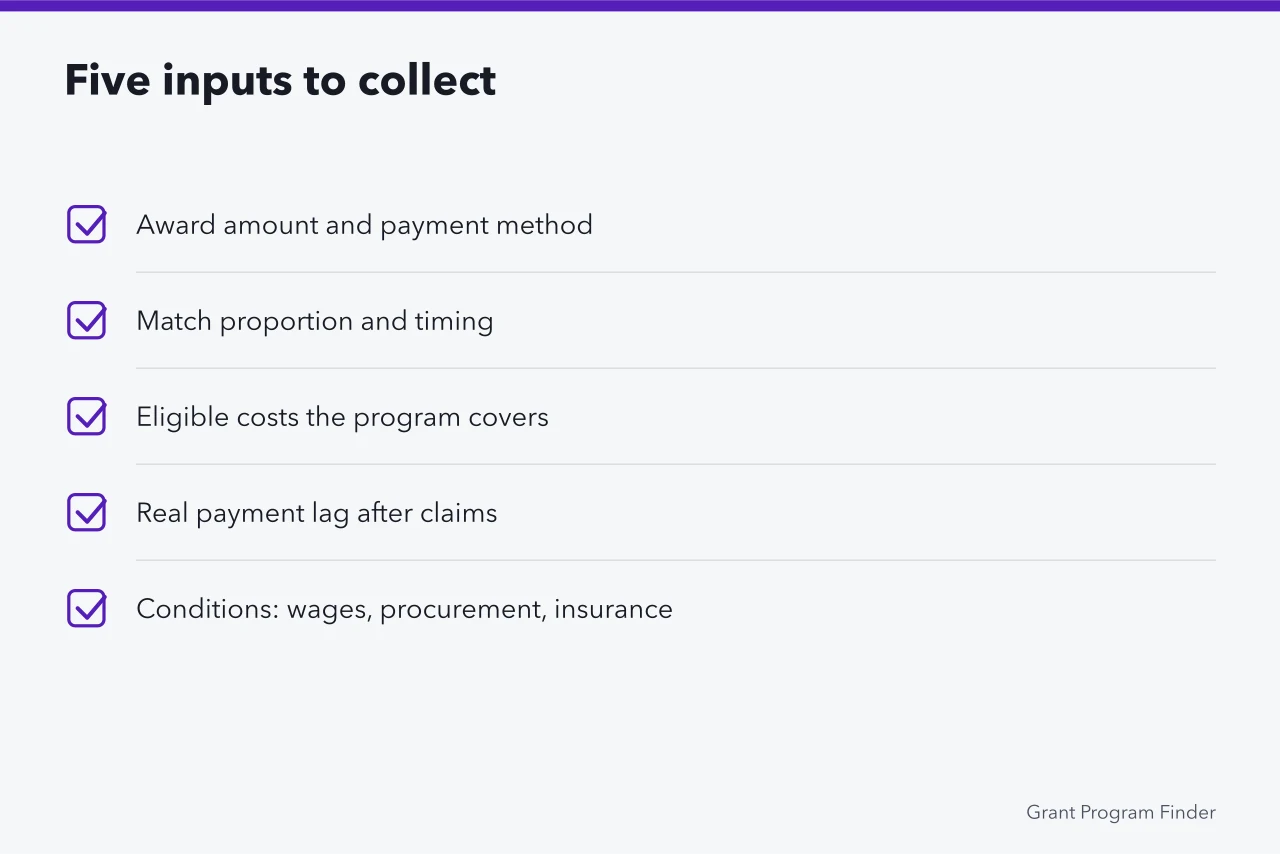
- The award amount and how it is paid. In advance, in stages, or as reimbursement against receipts.
- The match. What proportion, what counts toward it, and when it must be in place.
- The eligible costs. Which of your planned costs the program will actually pay for.
- The lag. How long between submitting a claim and receiving payment, in practice rather than in policy.
- The conditions. Wage rules, procurement rules, reviews, insurance, and performance commitments attached to the funded work.
Ask the administering body for the fourth one directly. Program staff know the real answer and will usually give it, and it is the input that most often decides the outcome.
Step one: the cash trough
Draw your spending over the life of the project, then draw the reimbursements arriving after their lag. The gap between the two lines, at its deepest point, is the trough.
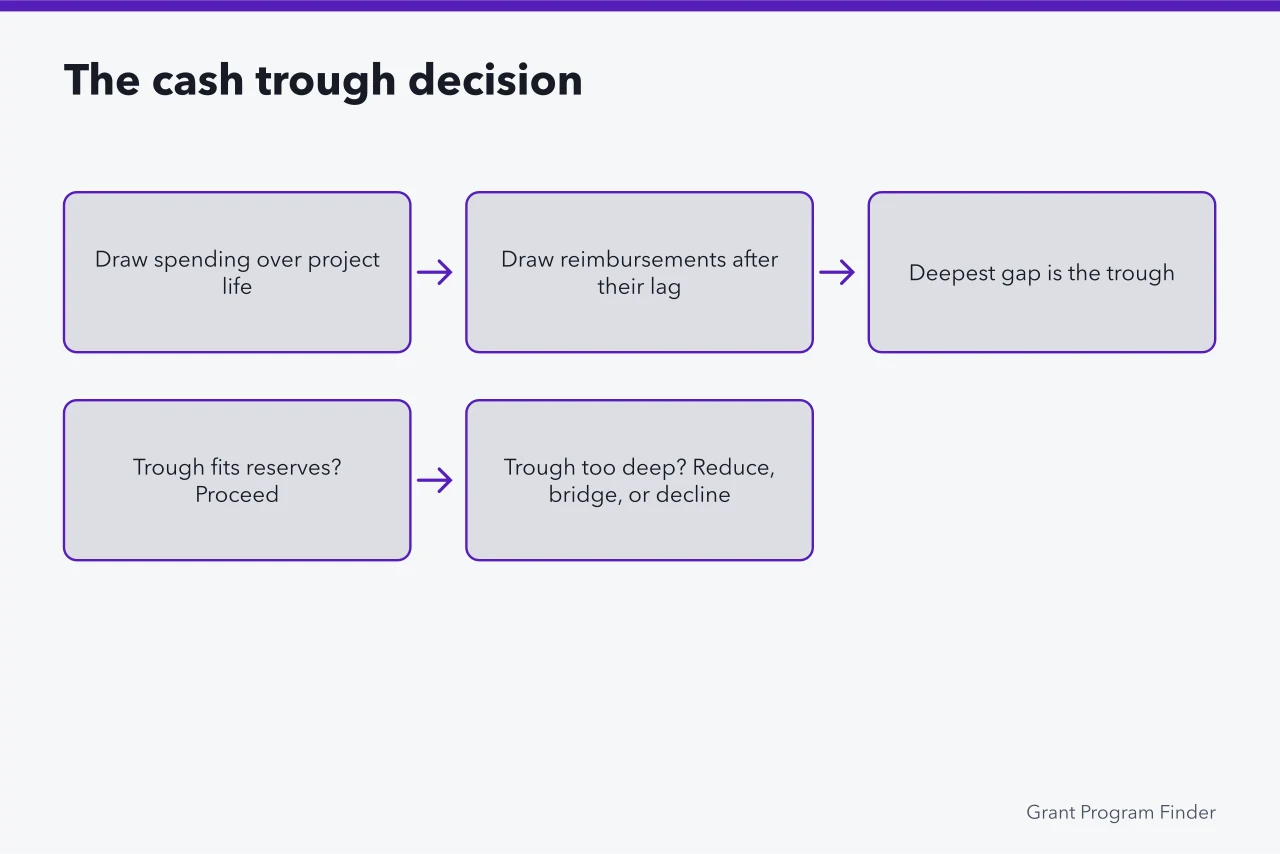
That number is what you must be able to carry. Not the total project cost, and not the match: the deepest point of the gap. Businesses fail this test with awards they were delighted to win.
If the trough is beyond your reserves, you have three options. Reduce the project so the trough fits, arrange bridge financing and price it into the project, or decline. Declining is a legitimate answer and often the correct one.
Step two: the cost of carrying it
If you bridge the trough with borrowing, the interest is frequently not an eligible cost, so it comes out of your own margin. Add it as a cost of the award.
If you carry it from reserves, the cost is what those reserves were otherwise doing, which is rarely nothing in a small business. Put a number on it anyway, because a cost you refuse to name is a cost you will underestimate.
Step three: the net value
Take the award. Subtract the match you contribute. Subtract the financing cost of the trough. Subtract the incremental cost of the conditions, meaning the difference between doing the work under public conditions and doing it without them. Subtract the reporting cost over the full obligation period.
What remains is the net value. Compare it against the effort of applying, what else you could do with the same weeks, and the alternatives on offer where you are, cataloged in the state offices worth calling.
The full inventory of what belongs in those subtractions is in what an award actually obliges you to do.
A hypothetical worked shape
Take an imagined project where the program pays part of the cost as reimbursement, the applicant contributes the rest, and claims are paid some weeks after they are filed. Spending runs ahead of reimbursement for the whole project, so the trough deepens until the final claim clears.
If the applicant's reserves are smaller than that trough, the award is unusable at that project size, regardless of how good the application was. Halving the project halves the trough, and a smaller award you can finance beats a larger one you cannot.
Those relationships are the point. The numbers are invented, and yours have to come from the notice and from the administering body.
What the arithmetic assumes
It assumes you are eligible, which is the actual gate and is decided before any of this matters. Geography screens first in this category, and it is checkable rather than arguable: the reasoning is set out in how the geographic gate works.
It assumes the money is a grant, too. Rural announcements cover grants, guarantees, forgivable loans, and technical assistance under one vocabulary, and the definitions worth working from are at the government's glossary of grant terms.
And it assumes nobody is charging you. Applying is free, being considered is free, and receiving an award is free. Distance makes rural applicants a specific target for fee-charging approaches, and the pattern is described in the FTC's account of government grant scams.
Common questions
What if the notice does not state the payment lag?
Ask the administering office. They know, they will tell you, and a program that will not answer is one you cannot plan around.
Can I count my own labor as match?
Sometimes, and the rules vary by program. Ask what counts before you build a budget on it, because an in-kind match that is disallowed at claim time leaves you funding the gap in cash.
Does a bigger award mean a better outcome?
Not if the trough grows faster than your ability to carry it. Fit between the project size and your reserves matters more than the headline.
Where do I find the free help to check this?
Publicly funded advisers will read the arithmetic with you at no cost: see the resource partners that counsel small businesses. The local bodies that administer money are worth a call too, as described in the offices that fund things near you.