Guides
Canadian arts grants for equipment: how to test business use before you buy
Canadian arts grants fund projects, not studio equipment by default. See where each funder states its cost rules, a business-use test to run before buying a press, and a budget-line table that separates the press from materials.
The costliest error is committing to a press before confirming whether the grant permits that purchase and when spending may begin. A machine bought for a business's ordinary production cannot be relabelled later as an arts-project expense. Check the applicant, project purpose, timing and eligible-cost rules before paying or signing an order.
Where each funder states its equipment rules
No single Canadian rule sets a business-use limit for arts equipment. Each funder writes its own eligible-cost list, and those lists change between competitions. This guide therefore quotes no cap and sends you to the source.
- Canada Council for the Arts:read the page for the exact program, such as Explore and Create, and the eligibility pages it links to, including "Am I eligible for a grant?"
- Ontario Arts Council:read the guidelines of the specific program you are applying to.
- Conseil des arts et des lettres du Québec (CALQ):read the rules of the artist program, linked below.
If the guidelines are silent on a press, ask the program officer in writing, and keep the reply with the application file.
A business-use test before you order
Run these five questions before paying for a press. Write the answers down.
- Who owns the press, the applicant or a business?
- Will the press make only the funded project, or also paid client work?
- If the use is mixed, what share belongs to the project?
- Could the project be made on a rented or shared press instead?
- Does the current cost list name equipment as eligible for this program?
A heavy share of paid client work points away from an arts grant and toward business funding. A press owned by the applicant and used for named project work is the clearest case to put forward, and still needs the written check in question 5.
Mistake: Paying before checking the project start date
Paying for a press before confirming the eligible spending window can make an otherwise relevant purchase unusable. Ontario information excludes retroactive purchases, and the described CALQ artist programs do not include costs incurred before the project begins. Timing is a separate eligibility check, not an administrative detail.
Before ordering, read the current conditions for the exact program and confirm when expenses may start. If the purchase is for ordinary business operations rather than a defined arts project, investigate other routes such as provincial economic development funding. A different funding route still needs its own eligibility check.
Mistake: Naming the machine but not its purpose
A budget entry that says press does not explain why the project needs the machine.
Without a clear connection to the work being produced, assessors have little basis to distinguish project production from general capital or a studio upgrade. The equipment name alone does not establish that the cost belongs in the request.
Describe the work the press will support and explain why an available shared press would not meet the project need. For an Ontario application, connect the equipment line to a described project and a specific cost. For Quebec, make the proposed use clear under the relevant program; a discipline label by itself does not prove business eligibility.
Mistake: Treating an arts award as general equipment finance
Arts councils assess proposed work, not simply the usefulness of machinery to a print business.
A press needs justification as a cost of making named work; a business need on its own does not establish that an arts council will fund the purchase. Compare the Canada Council and provincial routes before settling on a stream.
Use the Canada Council's Explore and Create program, its Creating, Knowing and Sharing program for First Nations, Inuit and Métis artists, and the Ontario Arts Council program guidelines as leads for checking current terms, not as confirmation that a company or purchase qualifies. Visual arts project grants still depend on the program rules and applicant type.
Mistake: Applying under the wrong name
An individual artist and an incorporated print business do not necessarily use the same funding route. Confusing who applies with who owns the press can leave a request framed for an applicant that the program does not accept, even when the proposed work itself is suitable for consideration.
Identify the applicant, press owner and intended use before drafting the budget. An eligibility pre-screen can help surface applicant and program questions. Band council resolutions address a different applicant requirement, while business funding options may be more relevant when the purchase serves ordinary company operations.
Mistake: Folding consumables into the press price
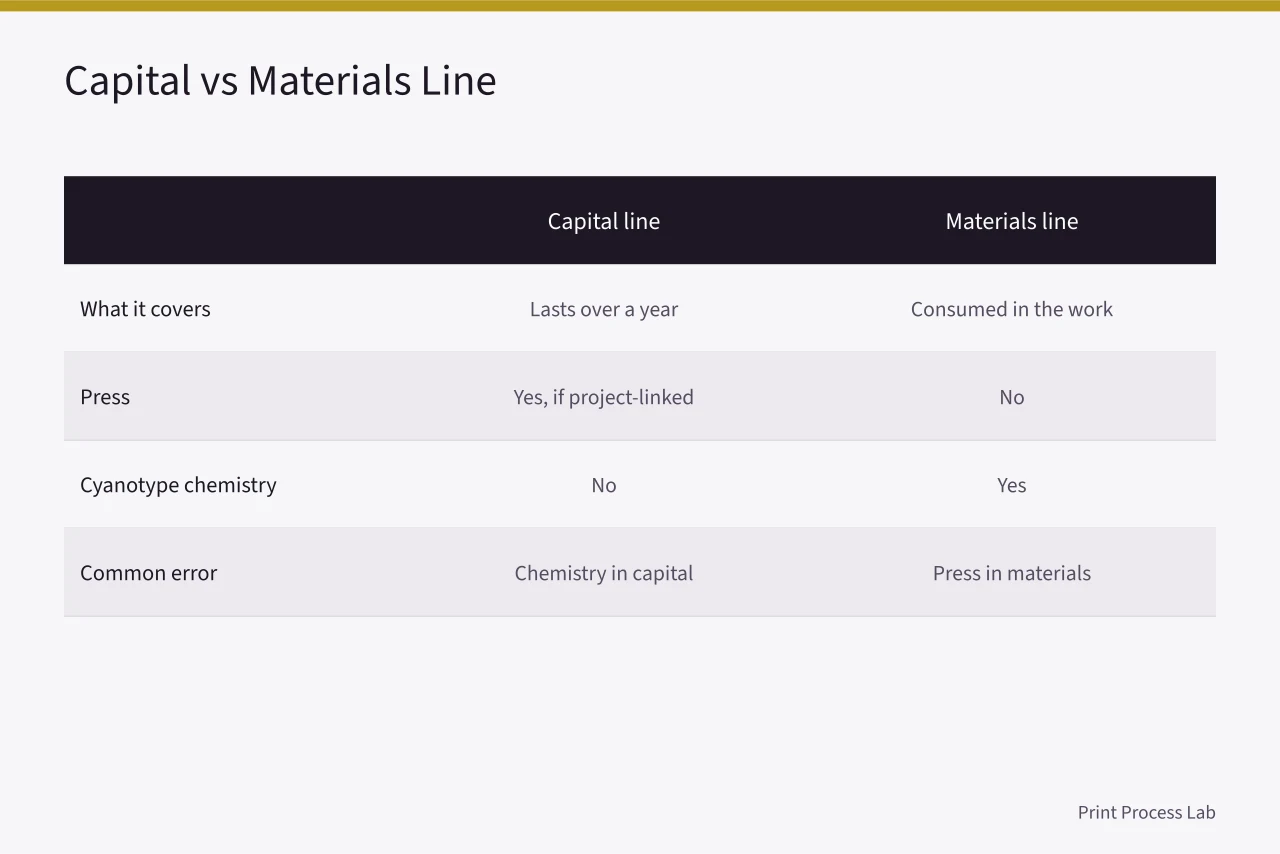
Cyanotype chemistry is used up in making work, so putting it into the press purchase line misclassifies the cost. Sensitiser, iron salts, paper and gloves belong in a materials or consumables line rather than capital. The distinction remains important even when both the equipment and supplies support one project.
List the chemistry and other consumables separately, with quantities, unit prices and a supplier. This makes the nature of each expense visible instead of hiding materials inside a capital request. It also lets the assessor consider the press and the supplies against their separate budget categories and the program's own cost rules.
Mistake: Assuming every reasonable expense is eligible
A plausible budget can still include costs that a particular program will not cover. Check each item against the current rules before calculating the request, and check whether the program expects other contributions to the project.
| Budget line | What to document | Main classification check |
|---|---|---|
| Press | Supplier quote | Capital or production cost, if permitted |
| Chemistry and paper | Quantities, unit prices and supplier | Materials or consumables |
| Safety items | Cost details | Check the program rules |
| Fit-up | Contractor quote and landlord letter if renting | Project expense or general studio cost |
| Shipping | Freight, duty and customs | Check whether the program permits it |
| Disposal | Local service price | Check whether the program permits it |
These categories are prompts for checking guidelines, not a promise that every item qualifies. The current competition rules determine which costs count for a specific request.
Mistake: Treating estimates as evidence
This guide gives no price for a press or for cyanotype supplies, because costs vary by size, supplier and edition. A rough figure from a web search is not evidence for the request.
Use a supplier quote for the press, and list chemistry and paper with the actual quantities and unit prices for the planned edition. A planning estimate is also not a program cap or an award benchmark.
If the press serves routine business production, choose a funding route suited to that purpose instead of recasting the expense as an arts project.