
Guides
Canada Council creative nonfiction grants: who may apply
Canada Council creative nonfiction grants go to individual professional artists, not companies. Here is who qualifies, what to file and where a business looks.
Canada Council creative nonfiction grants are made to individual professional artists, not to companies. This article names the Canada Council for the Arts streams and components that carry creative nonfiction, sets out the eligibility lines an individual writer has to meet, describes the document set an application asks for, and shows where a writer whose creative nonfiction runs through a business has to look instead.
What the Canada Council for the Arts is
The Canada Council for the Arts is Canada's federal, arm's-length arts funder. Established in 1957, it operates as a Crown corporation, makes grants to individual artists and to arts organizations, and runs prizes alongside its granting programs.
Its granting programs are grouped into six streams: Explore and Create; Creating, Knowing and Sharing: The Arts and Cultures of First Nations, Inuit and Métis Peoples; Engage and Sustain; Supporting Artistic Practice; Arts Across Canada; and Arts Abroad. Explore and Create is the stream an individual writer most often applies through. Creating, Knowing and Sharing serves First Nations, Inuit and Métis artists and their organizations. Arts Across Canada and Arts Abroad support travel and presentation.
Do not read a stream name as a locked door. Engage and Sustain and Supporting Artistic Practice are built mainly around arts organizations, but an individual artist is not automatically shut out: professional development components open to individual artists have been offered inside the Council's organization-facing streams. What decides your file is the "who may apply" wording on the component page you open, not the heading above it.
Which Council programs carry creative nonfiction
Creative nonfiction is treated as a literary genre at the Council, sitting beside fiction, poetry, drama, children's literature and graphic novels. Within Explore and Create, the components writers use most often are Research and Creation, which supports the research and writing stage of a project, and Concept to Realization, which supports the work that carries a project through to completion and public presentation.
The evidence each component expects differs. One may ask for a writing sample and a project plan; another may weigh a record of publication or public presentation alongside a plan for how the finished work reaches readers. The component's own guidelines state the career level, the genre eligibility and the publication expectations, and those lines decide whether you are applying in the right place.
Who qualifies: individual artists, not companies
An individual applicant must be a Canadian citizen or a permanent resident of Canada, and each program adds its own residency conditions. Applicants also have to meet the Council's definition of a professional artist: specialized training in the discipline, recognition by peers and a sustained commitment to artistic practice, whether or not the work pays the bills. Before drafting anything, run the same eligibility pre-screen you would use with any funder: applicant type, citizenship or residency status, and genre.
A for-profit company cannot use the Council's individual artist programs, and a commercial publishing venture is not an arts organization for the organization-facing streams. If your creative nonfiction runs through an incorporated business — a publishing company, a studio, a content firm — that eligibility rule, not the genre, decides the application, and the Council route is closed to that applicant.
Where the second layer sits: provincial and territorial arts councils
Provincial and territorial arts councils are the second layer for an individual writer. The Ontario Arts Council, the Conseil des arts et des lettres du Québec, the BC Arts Council, the Alberta Foundation for the Arts and the Manitoba Arts Council run competitions of their own, with their own forms, genres and reporting rules. A rule that holds at one of them does not transfer to the Canada Council, and the reverse is true as well.
What a company uses instead of an artist grant
Three national routes come up when creative nonfiction work is run as a business. The Canada Small Business Financing Program, administered by Innovation, Science and Economic Development Canada, backs loans that lenders make to small businesses; it guarantees part of a lender's loss rather than paying a grant. The Business Development Bank of Canada is a Crown corporation that lends to and advises small companies. Futurpreneur Canada pairs financing with mentoring for younger founders.
None of the three is a grant program. Each is delivered through a lender or a program agreement rather than through an arts competition, and each asks for a business plan rather than a writing sample. Canada's regional development agencies — among them the Atlantic Canada Opportunities Agency, Canada Economic Development for Quebec Regions, FedDev Ontario, FedNor, Prairies Economic Development Canada, Pacific Economic Development Canada and the Canadian Northern Economic Development Agency — deliver business programs of their own inside the regions they cover.
What an application asks for
The application is a document set, not a pitch letter. Most components ask an individual writer for five pieces: a project description, a work sample, a budget, a timeline, and a declaration of the other support committed to the same activity.
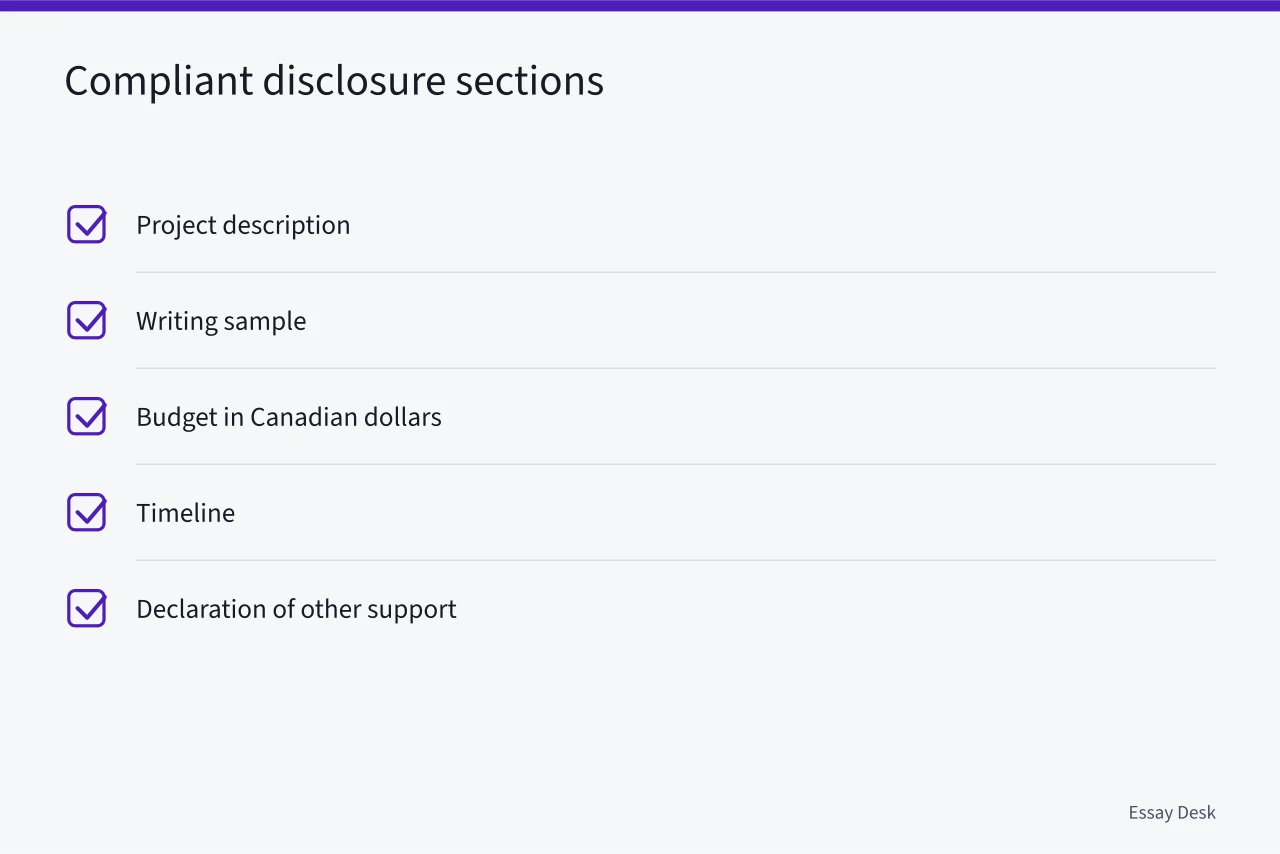
The guidelines set the limits. Page or word counts for a work sample differ by component, so choose your excerpt after you read the limit rather than before. The budget is prepared in Canadian dollars and has to line up with the eligible expense list in the same guidelines; costs outside that list are not covered by the grant. The declaration of other support covers every grant, prize, residency and fee already committed to the activity, including support that ends before your project starts, and an omission there is a compliance problem rather than a formality.
Each component publishes its own checklist. Build the file from that list rather than from a template borrowed from another competition, because the attachments and the assessment criteria are not interchangeable between components.
Deadlines and the order of work
The Canada Council publishes a central Deadlines page that lists grant deadlines across its programs, so you do not have to open every stream to see what is closing. Even so, the date that governs your file is the closing date printed in your component's guidelines, and dates can move between competitions. Read that guidelines page in the month before you plan to submit, and set a grant alert for the component you are watching, because a component can run once a year or twice.
A workable order of work:
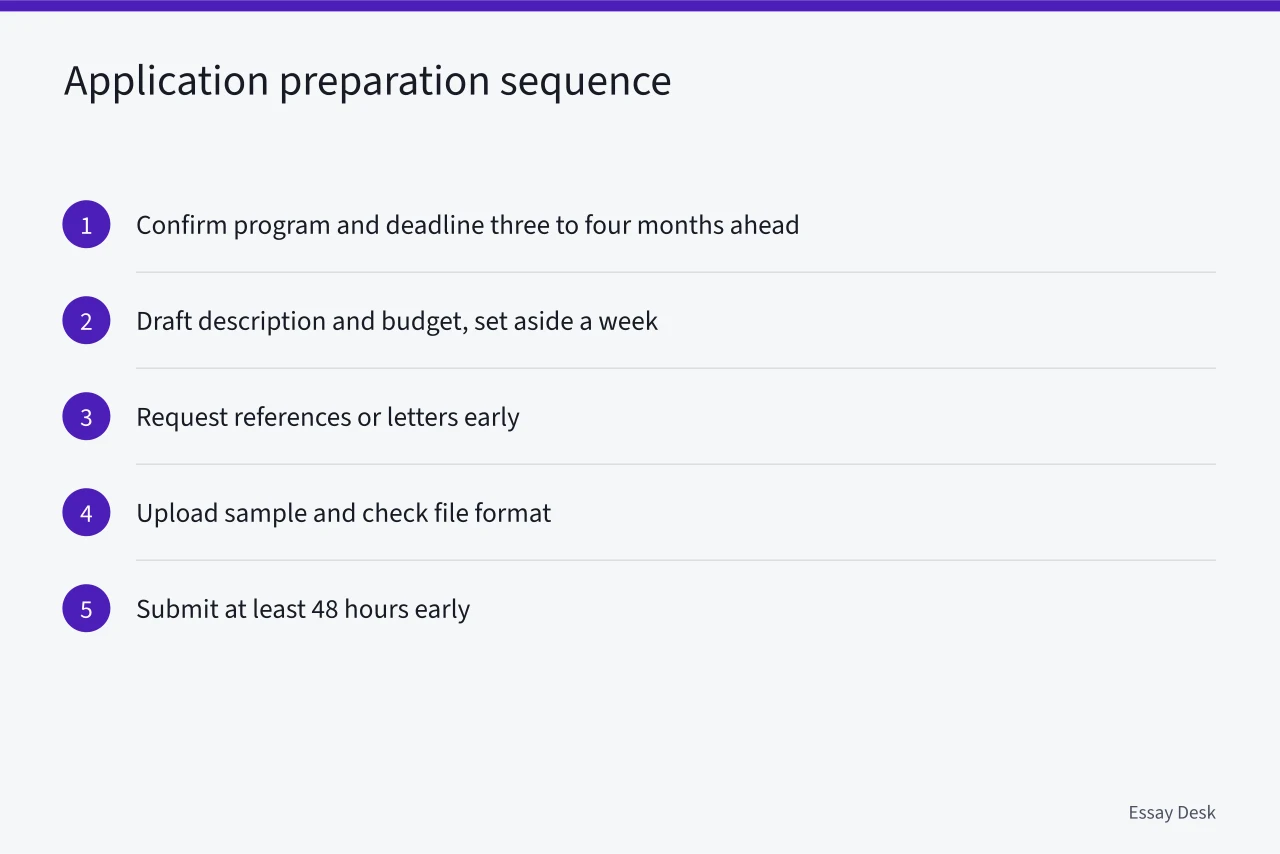
- Read the component's guidelines and confirm you meet the eligibility lines.
- Create or update your profile in the Canada Council Portal, the Council's online application system; nothing is submitted by email.
- Draft the project description and choose a work sample that fits the stated limit.
- Build the budget and the timeline in the format the guidelines require.
- Complete the declaration of other support and submit before the posted closing date.
After the award: records and reporting
A grant comes with an agreement, and the agreement, not a general rule, states how long records must be kept. Keep the signed agreement or award letter, receipts for grant-funded expenses, contracts with collaborators, editors or publishers, the final report you file, and the drafts or working files that show the work described was the work done. That habit of keeping a grant file is the same one that protects you in any funded project.
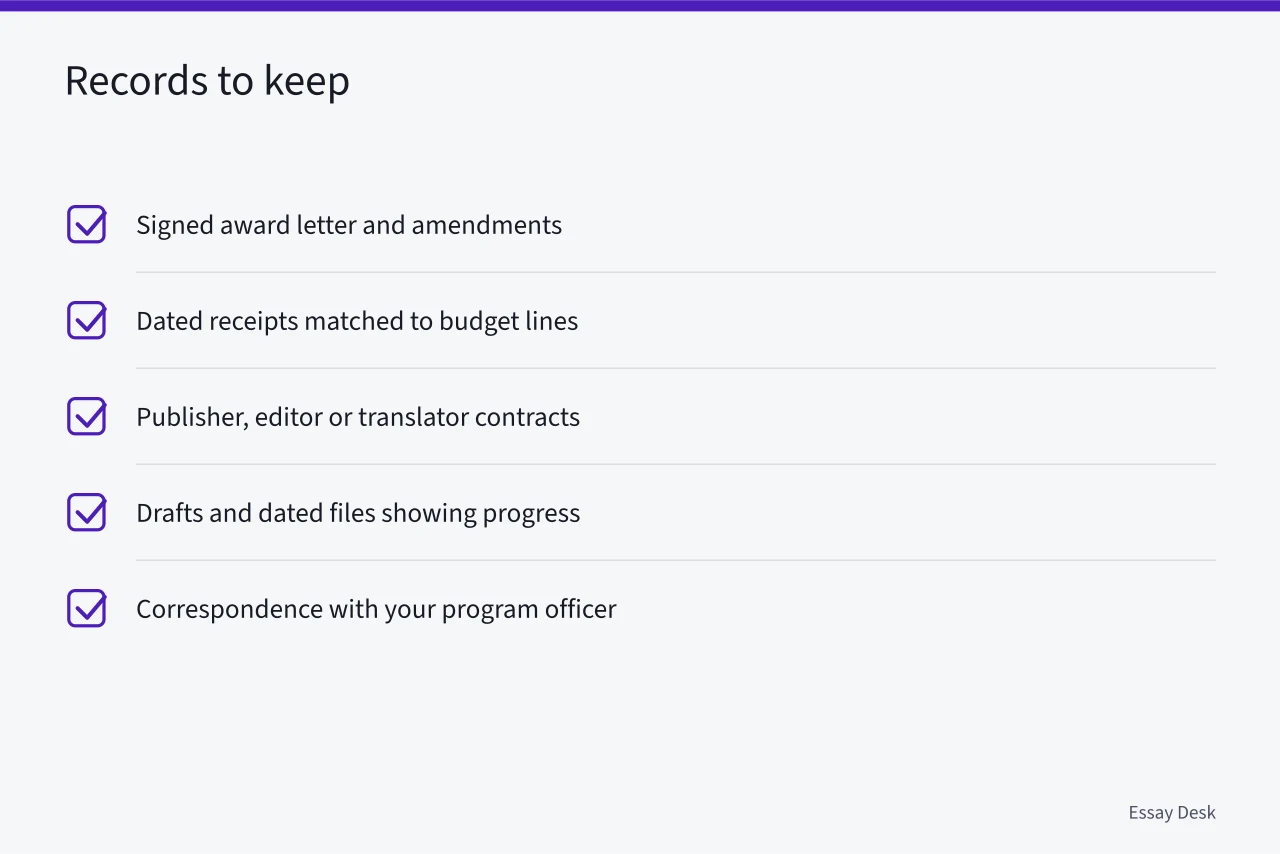
The final report is the deadline that catches writers. It is due on the date in the agreement, and a report filed late or not at all is a far more common compliance problem than deliberate misuse.
What happens if the terms are breached
A grant agreement lets the Council cancel an award and require repayment when a holder gives false information, fails to file a required report, or spends the money outside the approved project. An unresolved report or debt also surfaces in later applications, where the Council asks about outstanding obligations before it assesses a new project.
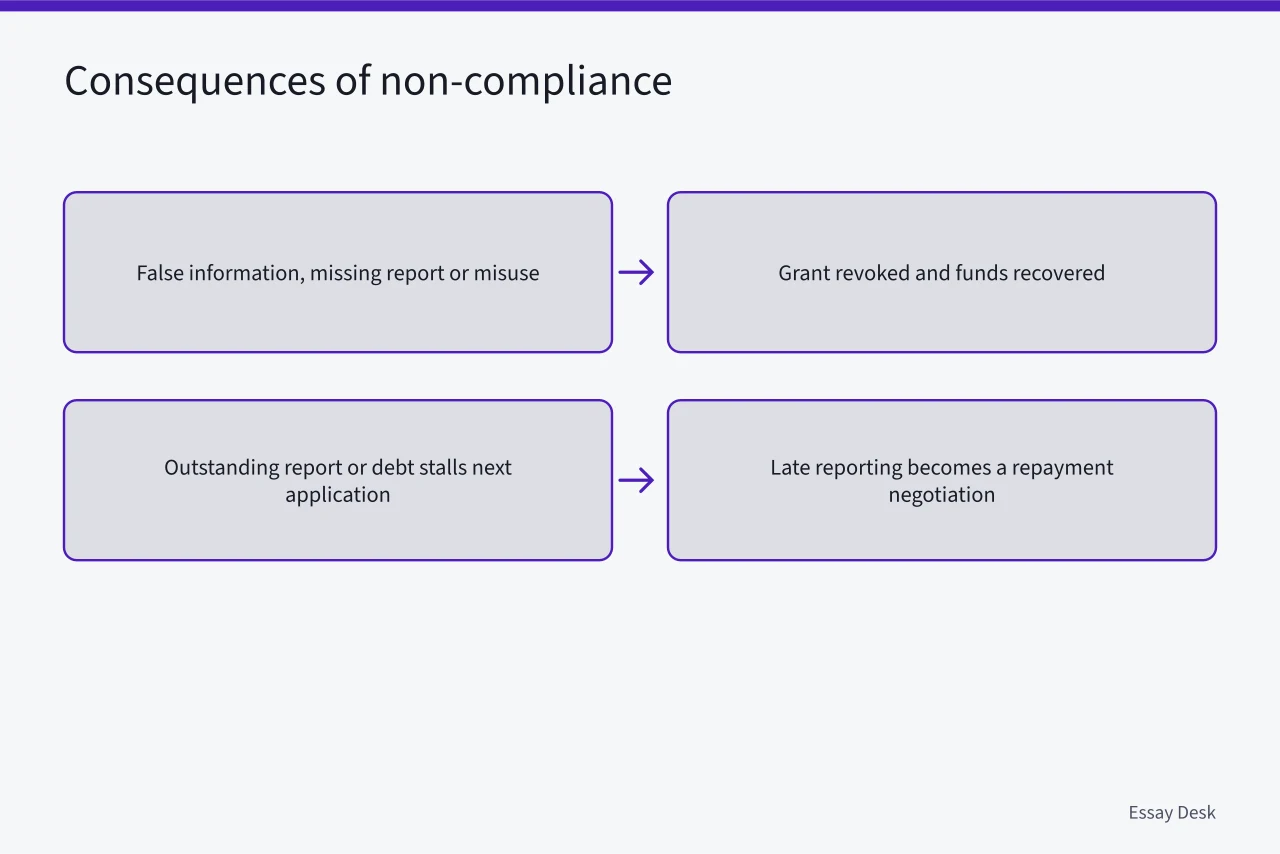
Corrections are cheap before the money moves and expensive afterwards. A funder missing from a declaration usually means the file is returned for a corrected version; the same fact discovered after payment turns into a repayment request and a negotiation.
Common questions
Are Canada Council creative nonfiction grants open to companies?
No. The individual artist programs are for individuals. Organizations apply through the organization-facing streams, which are built for non-profit arts bodies. A commercial publisher, or a writer's incorporated business, has to work with business financing instead.
Do I need a publisher before I apply?
Not always. Some components fund work in progress and ask for a plan rather than a contract; others weigh a publication or presentation record. The component's own eligibility and assessment lines settle it.
Can I apply to more than one component at once?
Usually yes, but each application has to be declared. Two awards for the same activity are generally not allowed, and the Council will ask you to choose.
Are the deadlines the same every year?
The Council lists program deadlines on its central Deadlines page, but the closing date inside your component's guidelines governs, and dates can move between competitions. Check that page and the guidelines for the round you are entering.
Where do I submit?
Through the Canada Council Portal, the Council's online application system, using the profile you create there. Nothing goes in by email.
Is a Council grant taxable?
A Council grant to an individual is generally income for tax purposes rather than a tax-free prize, so plan for the tax year in which the money arrives and confirm your own position with an accountant.