Industry
Nail salon operations: Indigenous funding routes in Canada
Nail salon operations for Indigenous owners in Canada: an overview of federal, provincial, community and Indigenous-lender funding routes.
What to take away
- Indigenous-owned salons in Canada are mostly one to four chairs, and the owner's community is usually the first client base.
- There is no national salon fund, and no program funds salons by name. Money comes from three directions: federal Indigenous business programs, provincial programs, and the economic development arm of your own First Nation, Metis or Inuit community. Most salons stack two of the three.
- Federal money arrives through the Canada.ca Indigenous services hub, regional development agencies and Indigenous financial institutions such as NACCA's member lenders.
- Typical amounts for a two-chair salon$15,000 to $40,000 for equipment, $20,000 to $60,000 for leasehold improvements, and $10,000 to $25,000 for working capital.
- Community Futures loans typically reach $150,000, and Indigenous financial institution loans commonly run from $5,000 to $250,000. Bank loans under the Canada Small Business Financing Program can go higher.
- Approval runs in two steps at most fundersa pre-screening call, then a written plan and budget. Expect four weeks to six months.
- Ontario publishes an Indigenous business development toolkit and a First Nations community economic development guide; Saskatchewan runs a dedicated First Nations, Metis and Northern business page.
- BC has no salon grant; money comes through First Nation economic development corporations, Indigenous financial institutions and Community Futures offices.
- Register the name provincially, get a CRA business number, and settle GST/HST and workplace safety coverage before the first paying client.
What an Indigenous-owned nail salon in Canada actually looks like
Most are small. Two to four chairs, one owner working the table, one or two technicians added once the book fills. The owner is often a band member serving band members, which sets both the price ceiling and the rebooking rhythm.
Publicly named examples include Neechie Nails, Dene Nails and Kwe Nails.
That shape decides who will fund you. A lender reads a lease, a price list and a chair count. Grant officers read the same three things.
The federal Indigenous Peoples services hub is the honest first stop. It lists programs across departments and links to the regional offices that process applications.
Funding sources by region and typical amounts
Most salons stack two sources: a contribution for equipment and leasehold work, and a loan for working capital. The ranges below are typical, not published caps.
Funding sources by region
| Region | Where to apply | What it usually funds | Typical amount |
|---|---|---|---|
| Atlantic Canada | Ulnooweg Development Group, ACOA | Equipment, working capital | $5,000 to $250,000 |
| Ontario | Waubetek Business Development Corporation, FedNor, FedDev Ontario | Equipment, leasehold, training | $10,000 to $100,000 |
| Prairies | Saskatchewan Indian Equity Foundation, Clarence Campeau Development Fund, Alberta Indian Investment Corporation, PrairiesCan | Equipment, leasehold, working capital | $5,000 to $250,000 |
| British Columbia | All Nations Trust Company, Nuu-chah-nulth Economic Development Corporation, PacifiCan, Community Futures | Equipment, small loans | $5,000 to $150,000 |
| North | Northwest Territories Business Development and Investment Corporation, CanNor | Equipment, freight, training | $5,000 to $150,000 |
| National | Canada Small Business Financing Program through a chartered bank, NACCA member lenders | Equipment, leasehold, working capital | Bank loans up to $1,150,000 |
For a two-chair salon the working figures sit below those ceilings. Equipment typically runs $15,000 to $40,000, leasehold improvements $20,000 to $60,000, and three months of working capital $10,000 to $25,000. Freight, ventilation and inspection costs push a northern total higher. What decides the final number is your lease terms, your chair count and the local wage rate.
Confirm current terms, ceilings and application windows with each funder. Program names and budgets change with every federal and provincial budget.
Before you apply, know your own numbers. Leasehold improvements, stations, ventilation, disinfection equipment and three months of working capital are the lines that decide whether a plan survives a landlord. Our breakdown of startup costs and funding covers those lines for Canadian salons.
Sequence matters as much as the numbers. Opening a chair before permits, insurance and registration are in place is the fastest way to lose a grant instalment, so sequence the launch so spending follows approvals.
Geography changes the arithmetic. A salon in Sioux Lookout faces different freight and inspection costs than one in East Vancouver. Northern and remote communities often qualify for travel, shipping and training subsidies that southern salons cannot access.
Federal funding routes and services for Indigenous entrepreneurs
Federal support is spread across several departments and agencies. Several of them fund the general costs a salon startup carries.
ca hub points to the regional development agencies: ACOA in Atlantic Canada, FedDev Ontario and FedNor in Ontario, Canada Economic Development for Quebec Regions, PrairiesCan, PacifiCan and CanNor in the North. Those agencies run small business funding streams that can cover equipment, marketing and digital tools.
Salon owners usually apply for the smallest tier, so the paperwork is lighter than a full growth loan.
Indigenous financial institutions are the other federal-adjacent route. They are Indigenous-governed lenders that blend commercial lending with business support. The National Aboriginal Capital Corporations Association is the umbrella body for that network, and its member lenders are listed by region.
Approval usually runs in two steps. A pre-screening call matches your request to a program, then a written application asks for a plan, a budget and equipment quotes. A contribution agreement with a regional agency commonly takes three to six months from first call to cash.
An Indigenous financial institution loan decision often lands in four to twelve weeks. Bank financing moves at the bank's own pace.
What federal money usually will and will not cover
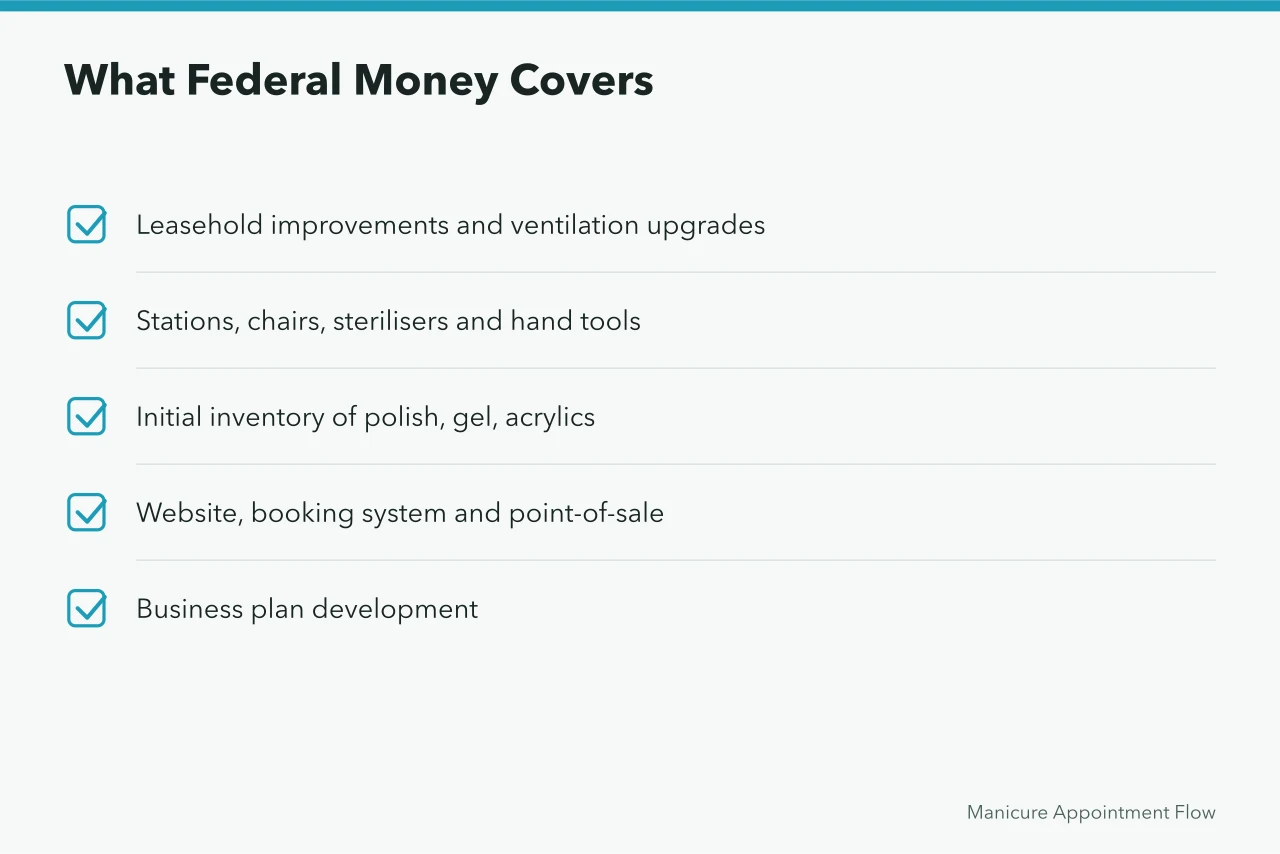
Most programs will not fund a personal vehicle, existing debt, or anything you cannot tie to the business. Keep receipts and a separate account from day one.
Ontario's toolkit, planning chapter and community guide
Ontario publishes the most detailed public guidance of any province for Indigenous entrepreneurs. The Indigenous business development toolkit covers business structures, financing, marketing and relationships with community and government.
Read it as a reference, not a course. Take the questions it raises to an advisor rather than working through every chapter.
The planning your business chapter is the one to read first. It sets out what a funder expects in a written plan: market evidence, operations, staffing and financial projections.
Ontario also publishes a First Nations community economic development guide, written for communities rather than individual owners. It matters because band councils and economic development officers use it when deciding whether to back a member's business on reserve.
Draft a two-page plan before you open the toolkit, so the toolkit corrects your thinking instead of replacing it. A plan that names your services, your price list, your hours and your first-year targets beats a long document with no numbers. Our guide to what belongs in a nail salon plan lists the sections a reviewer looks for.
If you plan to operate on reserve, ask the economic development officer which community processes apply before you sign a lease or order equipment.
Saskatchewan funding routes for First Nations, Metis and Northern businesses
Saskatchewan treats First Nations, Metis and Northern community businesses as a distinct client group. The province's community business programs page collects the programs aimed at them.
That page is the practical starting point for a salon in Prince Albert, La Ronge, Meadow Lake or a northern community. It points to business plan assistance, financing programs and advisory services delivered through provincial and partner groups.
The lenders behind most Saskatchewan approvals are the Saskatchewan Indian Equity Foundation for First Nations members and the Clarence Campeau Development Fund for Metis entrepreneurs.
The provincial approach leans on partnerships. Ministries work with Indigenous financial institutions, Community Futures groups and Northern municipal bodies, so in practice you apply through a partner rather than to a ministry desk.
How a Saskatchewan application moves through approvals
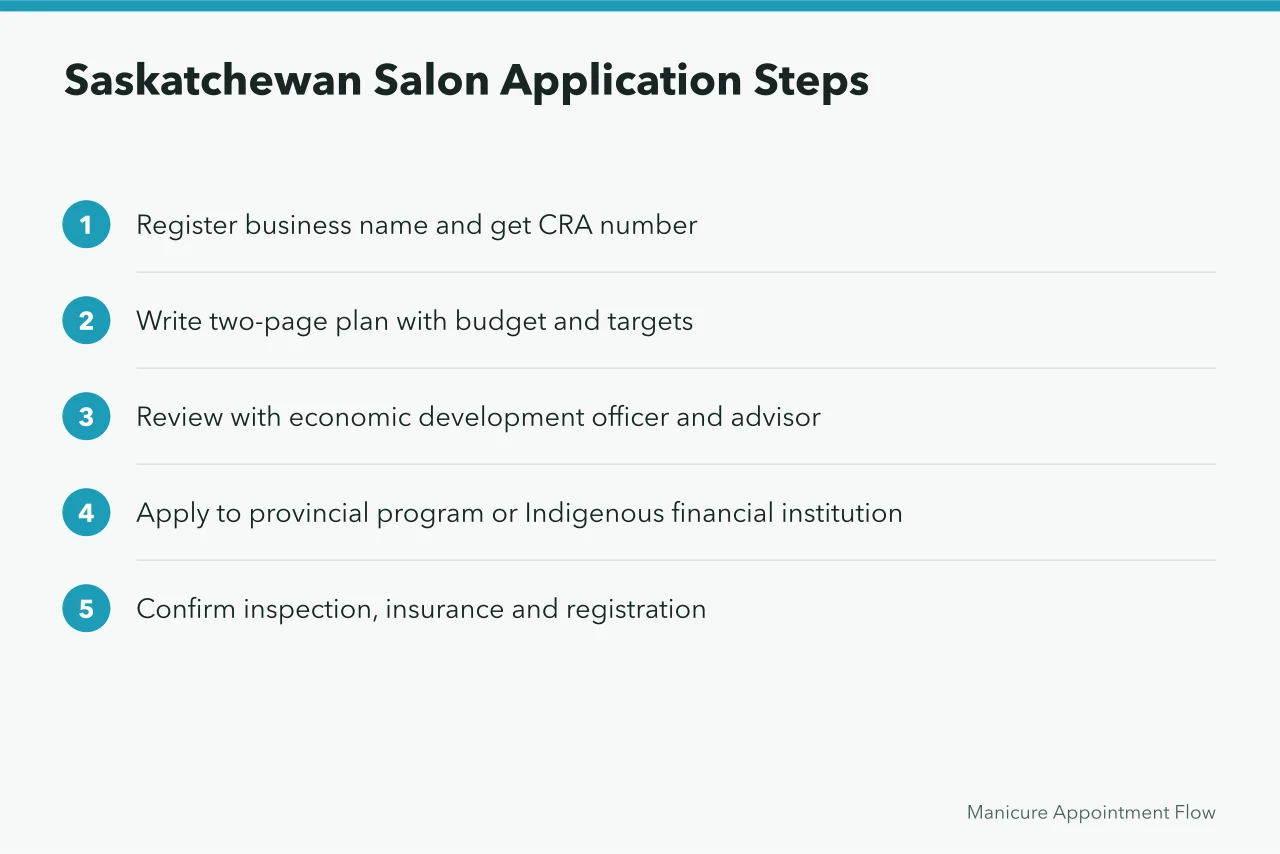
Suppose you want to open a two-chair salon in a northern community.
Saskatchewan application approvals
- Register the business name with Information Services Corporation and get a CRA business number.
- Write a two-page plan with a start-up budget, price list and first-year revenue target.
- Take the plan to your community's economic development officer and a provincial business advisor for review.
- Apply to the relevant provincial program or Indigenous financial institution for equipment and leasehold funding.
- Confirm inspection, insurance and workplace safety requirements before opening.
Step three is where most applications improve. Advisors know which program fits which request, and they will say when your ask is too broad.
BC economic development funding routes for salon owners
British Columbia has no single grant for nail salons. Money reaches owners through three channels: First Nation economic development corporations, Indigenous financial institutions, and Community Futures or regional trust programs.
Two BC lenders to start with are All Nations Trust Company, which lends to Indigenous businesses across the province, and the Nuu-chah-nulth Economic Development Corporation, which serves Vancouver Island and the central coast.
Economic development corporations owned by First Nations are often the most direct route for members. They may invest in a member's business, lease space, or lend alongside business coaching.
Community Futures groups cover rural and smaller urban areas and offer small loans plus free advising. Community Futures loans typically top out near $150,000. For a one or two chair salon, this is often the fastest realistic path to equipment money.
Vancouver and the Lower Mainland
In Vancouver, salon permits and inspections run through Vancouver Coastal Health and the City of Vancouver's business licensing process. Budget for a health inspection before you open, and check ventilation requirements for the space you intend to lease.
Lower Mainland commercial rents make the lease the largest single risk in the plan. An application that ignores rent-to-revenue ratios will not survive review.
Northern and interior BC
In northern BC, freight on supplies and equipment is a real line item. Some regional programs will fund a larger initial inventory so you are not reordering monthly at retail shipping rates.
Cold winters push clients toward longer appointments and add-ons in the slower months, which changes how you staff and price.
Training, ventilation and chemical safety
Training is the line funders approve least often. A short course may draw $500 to $3,000 from a provincial program, and the owner pays the rest.
Nail technician training in Canada runs through public colleges, private career colleges and community programs. Some provinces regulate nail technicians and some regulate only the premises, so confirm your province's rule before you enrol anywhere.
Training costs funders rarely cover
- Public college certificate or diploma in nail technology or esthetics
- Private career college programs, usually shorter and more expensive
- Manufacturer and distributor training on gel, acrylic and e-file systems
Ventilation is the cost new owners underestimate. Acetone, methacrylate monomers and filing dust all need source capture at the table plus general room air, and the Canadian Centre for Occupational Health and Safety publishes guidance you can cite in a plan. Confirm what your health authority requires for the space you lease.
Mentorship tied to a lender or an advisor
Mentorship programs for Indigenous entrepreneurs usually pair you with an owner in a different sector. That still helps with pricing, staffing and landlord negotiations, even if your mentor has never held a nail file.
Look for mentorship through Indigenous financial institutions, provincial business advisory services, chambers of commerce and industry associations. Ask for a fixed number of sessions with a written agenda rather than an open-ended arrangement.
Registration, taxes and record-keeping for a new salon business
Registration comes before funding in most reviewers' minds, because it shows a real business rather than an idea.
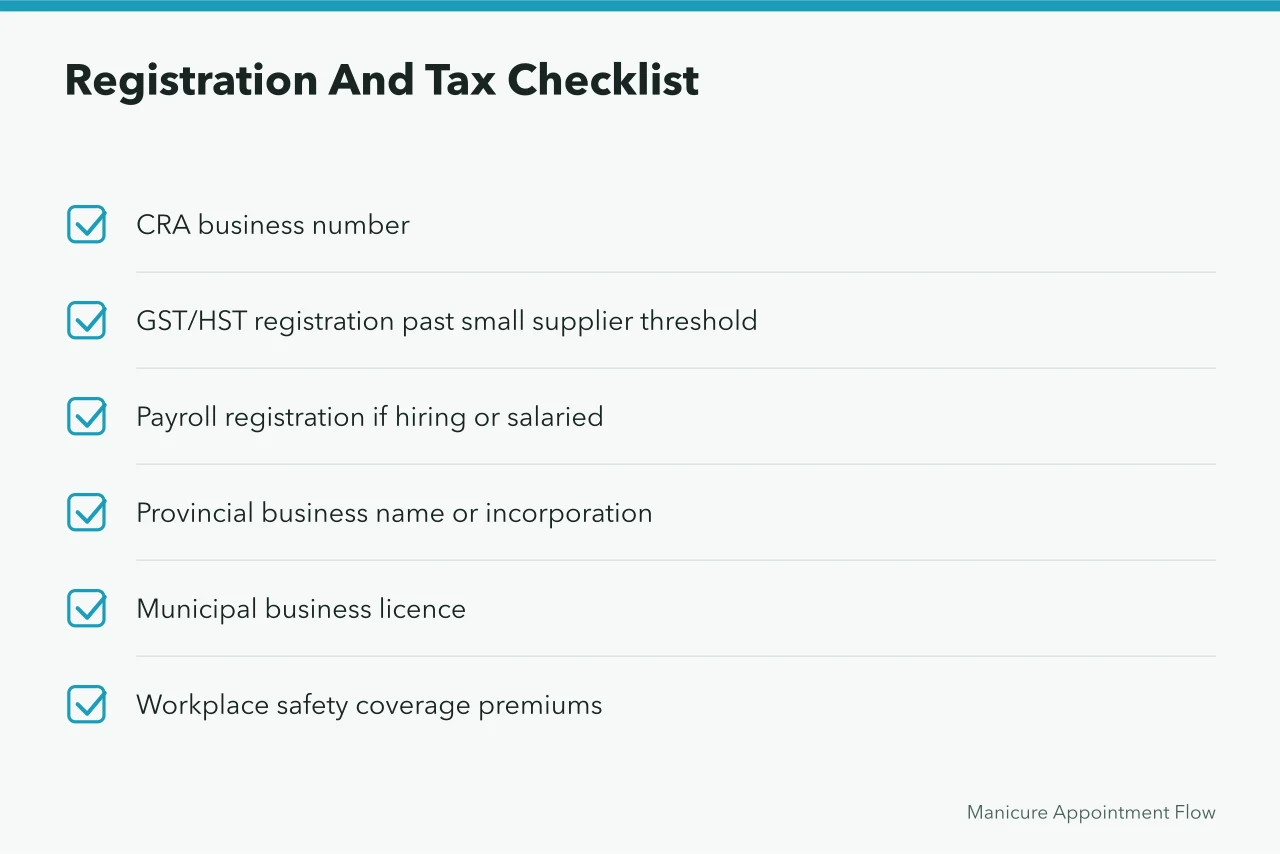
Federal registrations
Get a CRA business number. Register for GST/HST once you pass the small supplier threshold, and register for payroll if you will draw a salary or hire technicians.
GST/HST applies to salon services in every province, but the rate and the rules differ. Confirm the current treatment for personal services with the CRA.
Provincial and municipal registrations
Register the business name provincially, or incorporate if you want limited liability. Then get a municipal business licence, which is separate from health approval.
Health authorities such as Toronto Public Health and Vancouver Coastal Health inspect salons and set equipment and disinfection standards.
Workplace safety coverage is provincial: WorkSafeBC in British Columbia, WSIB in Ontario, CNESST in Quebec. Budget for premiums from your first payroll.
Record-keeping that survives an audit
Keep a separate bank account, record every cash sale, and file receipts by month. Use booking software that exports revenue reports, because a funder or lender will ask for them.
Insurance is not optional. Commercial liability and contents coverage protect you if a client is injured or equipment fails, and most landlords want proof before handing over keys.
Common questions
Can I get federal funding specifically for a nail salon?
Federal Indigenous business programs and Indigenous financial institutions fund small service businesses generally, so your application competes on the plan and the numbers. A two-chair salon with a written price list and a signed lease is a fundable business. Ask a lender which stream fits your request before you write the plan.
Do I need a business plan to apply?
Almost always. Ontario's planning chapter and Saskatchewan's business advisors both expect a written plan with market evidence and financial projections before they discuss money. Two pages with real numbers beats twenty without.
Is nail technician work regulated in Canada?
It varies by province. Some provinces license or certify nail technicians, others regulate only the premises through health authorities. Confirm the current rule with your province's board or health authority before you enrol in training or sign a lease.
What taxes apply to salon services?
GST or HST applies to personal services, with provincial sales tax added in some provinces. Register with the CRA once you exceed the small supplier threshold, then charge the rate for your province. Confirm the current treatment with the CRA rather than relying on an older price list.